If you are interested in a bunch of slow-moving, art-fartsy, non-commercial movies with spiritual themes, you might not find a better list of 100 movies than this one.
http://artsandfaith.com/t100
(Click here for some background on the list.)
Showing posts with label movies. Show all posts
Showing posts with label movies. Show all posts
Monday, August 2, 2010


Wednesday, April 29, 2009
Trivial Art
I don't 100% agree with these two quotes. Actually, I think I probably only agree about 45-55% what they are saying. But, I think the sentiments are interesting. If we're properly involved in the world and staying appropriately busy in things that are important, will the need for the art house movies and certain types of more philosophical literature still be important? Or, will our breaks in ministering to those around us cause us to desire lighter fair? Does an acquired taste for higher quality art come from too much wasted time? ...I think there's some interesting thoughts floating around that neighborhood (and some unhelpful dichotomizing).
"Anyone who is currently constructing “a nine-hour exploration of ‘personality’”, it seems to me, has completely forgotten about his audience, or at least the conventional notion of an audience, full of people with jobs and worries and dependants, people who are tired after a hard working day or week. My suspicion is that the policeman and the teacher and the nurse who works in a hospice does not feel infantilised in the least by someone’s desire to keep them entertained and diverted; rather, they are grateful for it. The job of providing these diversions, however, can occasionally seem less than adult: writers sit around in jeans and old T-shirts for large parts of the average working day, eating biscuits and watching some of the funnier acts from ‘Britain’s Got Talent’ on YouTube, while their friends and contemporaries don suits, rush off to meetings, save lives, keep entire transport systems running. Perhaps inevitably, there is a desire to compensate for the lifestyle, produce plays and books and films that are no fun whatsoever in an attempt to convince the world outside our offices that a day in front of the word-processor is the equivalent of eight hours down a Siberian salt-mine."
- Nick Hornby
Doug Wilson on Fireproof:
"If I set myself to think of couples in marriages that I think would be greatly helped by watching this movie, I would run out of fingers inside of a minute. I can also think of Christians who would be offended by the schlock, but many of them would be those who know more about how a movie ought to be made than about how a woman ought to be treated. And they would rather watch a movie about a woman being abused so long as the movie was made right than to have the woman treated right in a movie that offended their refined sensibilities. So which is the altar and which is the sacrifice?"
"Anyone who is currently constructing “a nine-hour exploration of ‘personality’”, it seems to me, has completely forgotten about his audience, or at least the conventional notion of an audience, full of people with jobs and worries and dependants, people who are tired after a hard working day or week. My suspicion is that the policeman and the teacher and the nurse who works in a hospice does not feel infantilised in the least by someone’s desire to keep them entertained and diverted; rather, they are grateful for it. The job of providing these diversions, however, can occasionally seem less than adult: writers sit around in jeans and old T-shirts for large parts of the average working day, eating biscuits and watching some of the funnier acts from ‘Britain’s Got Talent’ on YouTube, while their friends and contemporaries don suits, rush off to meetings, save lives, keep entire transport systems running. Perhaps inevitably, there is a desire to compensate for the lifestyle, produce plays and books and films that are no fun whatsoever in an attempt to convince the world outside our offices that a day in front of the word-processor is the equivalent of eight hours down a Siberian salt-mine."
- Nick Hornby
Doug Wilson on Fireproof:
"If I set myself to think of couples in marriages that I think would be greatly helped by watching this movie, I would run out of fingers inside of a minute. I can also think of Christians who would be offended by the schlock, but many of them would be those who know more about how a movie ought to be made than about how a woman ought to be treated. And they would rather watch a movie about a woman being abused so long as the movie was made right than to have the woman treated right in a movie that offended their refined sensibilities. So which is the altar and which is the sacrifice?"
Sunday, April 12, 2009
If I Only Had 4 Sentences to Describe Twilight (the movie)
Twilight is a 122 minute lusty sex scene without nudity so that no one realizes that they are actually watching an 122 minute epic on lust.
I wasn't sure I'd be able to control my dry heaves after Belle spoke breathlessly for the 265th time.
There's a 100 year old vampire in love with a teenager...it doesn't get much creepier than that.
Other than that it's gripping.
Things to Like About Slumdog Millionaire
Slumdog Millionaire…
…contrasts the results of living for yourself vs. living for others.
…honestly presents the evils of the world in a disturbing but discrete way.
…shows that the qualities of your youth amplify themselves as you become an adult.
…commends unconditional love. If you’re feeling generous, it commends grace-filled love.
…can easily be interpreted as alluding to a God who has ‘written’ history.
Wednesday, March 11, 2009
Bella
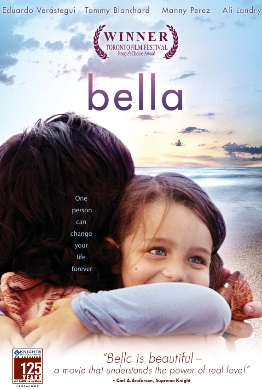 I finally broke my bad-movie streak. It's hard to tell for sure, but I think I had seen about 104 PG-13 romantic comedies in a row...all of them required the brain power of a green pea to get the nice moral message that when you really love someone you should make out, take off the man's shirt and then fall into a bed that is off camera...I'm assuming not much happens after that.
 ...but, then Bella came along. And, it reminded me that movies can feel almost perfect at times. It submits it's pro-life message artistically without preaching at people or letting the message overpower the emotions of the movie, although I would argue that the entire movie is about life (and in some ways, it's sanctity). I'm not sure how Christians decide which movies they are going to turn into sleeper hits...but, in my perfect world, I wish Bella would have drawn the lucky straw...
So, if you haven't seen it already, give it a shot. It reminds me alot of life...everywhere you look, there's sadness...but, between the sad stories there's usually some optimism in the air and redemption waiting around the corner.
Tuesday, October 14, 2008
Akira Kurosawa Interviews

I briefly read through the Akira Kurosawa Interviews tonight (edited by Bert Cardullo). Here were some of my favorite parts.
1963 - "Nothing could be more difficult for me than to define my own style. I simply make a picture as I wish it to be or as nearly as it is within my power to do so. I have never thought of defining my style. If I tried such a thing, I would be caught within my own trap." (25)
1966 - "There are so many things which portray violence and so many films show this. Somehow, I feel tired of it. It is easy to be happy. If it is necessary to show violence in a film, it is good to avoid ugliness...There are already too many films that show sex. I do not want my films to be another vehicle for it. Besides, I do not think it should be a purpose for entertainment. Children would not be able to understand it; it will only complicate their minds, and they will not be entertained." (32)
1975 - "Where films are concerned, if you set out to convey some special message or thesis you will become narrow and rigid. I think it is true for any other creative work as well." (58)
.
1980 - "...there's a tradition in Western films that deal with cavalry battles, whereby one almost invariably fires to hit the rider. In terms of real battle strategy, however, this is entirely unrealistic because the horse is a much bigger target and if you wanted to disable the whole cavalry, you'd get rid of the horses first. But nobody has ever made a film that way. The convention is to shoot the rider and see him fall off and the response to the film comes from that. I felt that this tradition has already worn out and wanted to try something different, more effective, for the sophisticated film audiences of today--to show the final effect of the battle rather than those shootings themselves. Besides, when you have a stuntman on a horse who knows he's going to be shot, this is apparent in his whole physical attitude. The audience also knows it's going to happen, so why show them what they already know?" (72-73)
1986 - "Ideally, a film should be spherical. This is physically impossible; however, it is possible to approach such a shape. A film should appeal to sophisticated, profound-thinking people, while at the same time entertaining simplistic people. Even if a small circle of people enjoy a film, it will not do. A film should satisfy a wide range of people, all the people." (141)
1986 - "CINEASTE: Once you said that the most important thing for young people aspiring to become directors was to read world classics. Do you still believe so?
.
KUROSAWA: Definitely. To read everything is almost impossible, so you must find writers that you like. Then, to find favorite works of these writers, and read them again and again. Therefore, your understanding of the characters in these works is deepened. One's level of understanding after reading a work once, and after reading it ten times, is naturally different." (143)
.

...if I ever complain about not having any free time, feel free to slap me.
Tuesday, August 19, 2008
Evil in the Movies
 I'm still thinking about the evil-in-the-movies concept I brought up a few posts ago (The Dark Knight). At the risk of implying a tidiness that I don't think exists...
 Which says more about our attitude toward evil...1) an explicit rendering of what is evil, or 2) a discomfort that prevents us from visualising it?
Which paints a better picture of evil...1) an explicit rendering of evil acts, or 2) an explicit rendering of the consequences of evil acts?

Monday, August 4, 2008
Thoughts on The Dark Knight
I think it happened again last week. Further desensitization. I remember the first time I saw Saving Private Ryan and The Passion of the Christ and soon realizing that I don’t want to see them again because they are built on the shock of their violence. If I keep watching them, they lose their punch. The first time I saw The Fellowship of the Ring I went away distressed at the clear way in which evil was visually portrayed in the orcs.
And, last week I saw The Dark Knight and again left the theater wondering about evil depicted in the movies. It seems like we might be part of an un-winnable battle. We can become more and more explicit in our depictions of what is wrong…but will a generation ever hit the evil threshold and say “okay, now we’ve finally got a handle on the darkest depths of evil…we can no longer top ourselves”. Or, will we continue an infinite trip down the dark layers of our hearts?
My mind gets fuzzy every time I think about it because there are two sides of the argument. On the one hand…are we actually telling the greatest of lies when we portray evil as anything but the disturbing, pit of darkness that it is? When we pretty it up, so that it is not difficult to look at, are we actually insulting all those who have been touched by its pain?
But, then, when does the game go from artistic to pornographic? If we take The Dark Knight for example, so many times the camera takes us up to the second before death and then turns away. There’s only so much we need to see and then we are indulging in things that don’t need to be seen. A slasher movie takes you on the full ride. It takes you to the point of death and then presses forward allowing the pleasure of the removal of all curiosities.
So, we have somewhat of a dividing line. Show all the evil except for the final act of hatred. But, maybe we aren’t dealing with a very good dividing line? Maybe the mystery should begin earlier? Maybe the line of indulgement exists sooner than we think? …we might be reveling in unprofitable areas because the camera doesn’t turn away when it should.
There are no easy answers…but, if nothing else, I think it’s good to be aware of our slow slide into further realism and explicitness. There has to be consequences here, perhaps of a moral nature, so it would seem wise to be alert to the desensitizing effects surrounding us.
And, last week I saw The Dark Knight and again left the theater wondering about evil depicted in the movies. It seems like we might be part of an un-winnable battle. We can become more and more explicit in our depictions of what is wrong…but will a generation ever hit the evil threshold and say “okay, now we’ve finally got a handle on the darkest depths of evil…we can no longer top ourselves”. Or, will we continue an infinite trip down the dark layers of our hearts?
My mind gets fuzzy every time I think about it because there are two sides of the argument. On the one hand…are we actually telling the greatest of lies when we portray evil as anything but the disturbing, pit of darkness that it is? When we pretty it up, so that it is not difficult to look at, are we actually insulting all those who have been touched by its pain?
But, then, when does the game go from artistic to pornographic? If we take The Dark Knight for example, so many times the camera takes us up to the second before death and then turns away. There’s only so much we need to see and then we are indulging in things that don’t need to be seen. A slasher movie takes you on the full ride. It takes you to the point of death and then presses forward allowing the pleasure of the removal of all curiosities.
So, we have somewhat of a dividing line. Show all the evil except for the final act of hatred. But, maybe we aren’t dealing with a very good dividing line? Maybe the mystery should begin earlier? Maybe the line of indulgement exists sooner than we think? …we might be reveling in unprofitable areas because the camera doesn’t turn away when it should.
There are no easy answers…but, if nothing else, I think it’s good to be aware of our slow slide into further realism and explicitness. There has to be consequences here, perhaps of a moral nature, so it would seem wise to be alert to the desensitizing effects surrounding us.
Sunday, November 4, 2007
Need Help With "The Pianist"
Somebody's going to have to help me out with The Pianist. It's been on my need-to-watch list for a while, so I realize I'm having this discussion a little late in the game.
It conveyed that the Nazis were bad...but, I've seen that before. It was mostly about this guy locked up in apartments, being alone. But, it didn't have that I'm-alone sense that Castaway had. Maybe it was about how music can bring even enemies together? But, there was only really one scene that pointed to that. It seems with all the buzz that came along with the movie that there must be some underlying theme that passed me by.

It conveyed that the Nazis were bad...but, I've seen that before. It was mostly about this guy locked up in apartments, being alone. But, it didn't have that I'm-alone sense that Castaway had. Maybe it was about how music can bring even enemies together? But, there was only really one scene that pointed to that. It seems with all the buzz that came along with the movie that there must be some underlying theme that passed me by.
Saturday, November 3, 2007
Why I Pretty Much Hated "The Devil Wears Prada"

 There was a moment at the end of The Devil Wears Prada when I felt as though the whole movie might have been redeemed. The movie is about the allure of power...success...and, I suppose fashion fits in as well. The young novice character (Anne Hathaway) gets a job working for a super-influential clothing designer. Guess what? Our novice knows nothing about clothes, nor does she give a rat's patootie for fashion. Guess what else? By the end of the movie her rags turn to riches (cliches seem appropriate here) and she becomes one of "them"... By "them", you know what I mean...those rich folks in the high rises, snooty, consumed with their jobs and absolutely nothing else. (To be fair at this point, I should point out that Meryl Streep does a good job with her character.) The good guys are Hathaway's friends at the bar, the bad guys are the ones making money. So, our rookie fashion character is slowly pulled to the dark side...and, there's this scene where Meryl Streep and Anne Hathaway are in the car together and Meryl Streep tells her devoted protege that they are quite similar...they're made out of the same material, if you will. It's at this moment that I thought the movie was coming together. If the last 1.5 hours of light-hearted display of transformation into a snooty fashion figure were for a purpose...and, if this purpose was to show how easy it is to be sucked into a vice....then, we were on to something good. What if Meryl Streep had used her cunning to trap Anne Hathaway into a situation she really could not get out of? What if Anne Hathaway at this moment discovered that she did love her career and her power and her new wardrobe more than everything else in the world...and she decided to continue down this road?
Because it is easy to get trapped in a situation that is pretty horrible because a bunch of little slippery steps have caused you to slide into this spot you never thought you'd end up in. And, in a movie depicting this, I can see how this process could be displayed as it was in The Devil Wears Prada. So, at this moment of the movie, I was hoping for a little severity. I was hoping that she was stuck in the bed she had made...I was hoping that she discovered that she was just like Meryl Streep's character...I was hoping for a little of Al Pacino / Keanu Reeves in The Devil's Advocate and less of what I'd been fed up to this point.
 Well, Anne Hathaway gets out of the car, tosses her cell phone in the fountain, and gets a regular job of her dreams. ...There are basically no repercussions to her actions over the course of the movie. She gets what she wants and all is good in the world. In my mind this ruins what was shaping up to be merely an average movie anyway. How bad is a situation that has no repercussions? I mean, really, are we concerned at all about realism if you can screw your friends and your family, work yourself to death and then pause and go back to normal. If the non-repercussion part of the movie is real, then, the rest of the movie that portrays Anne Hathaway as heading for trouble is a lie. I don't see how both can be true.
Like I said, it wasn't that great of a movie to begin with. And, as always, I'm reading too much into this little popcorn flick. But, as an easily annoyed person, this one bugged me with its basic lie and its flippant ending.
Thursday, October 18, 2007
Little Miss Sunshine Revisited
So, I got two comments and a taunting Email from my last post. Naturally, I’m thinking Little Miss Sunshine is really bringing in the hits to my blog, so I better give the fans more of what they want. So, here’s a snippet into my mind where I overanalyze the movie and life in general.
I’m pretty sure society is extremely wicked, screwed up, troubling, sinful…pick your adjective and/or verb. But, I have a hunch that in some sense it’s about a gazillion times worse than what we think it is. The reason it’s worse is because people show you what they think they want you to see. They pretty up their problems and misery so that they can keep up with the “prettiness” their neighbor has created in their own life. If the dressed up version is as bad as some of the dressed-up-versions are, I have a hunch that there’s a lot of crap going on behind people’s doors. Verbal abuse, physical abuse, internet porn of all shapes and sizes, prejudice, hatred…
But, what if people didn’t hide how depraved and flawed they really are? Think about it for a second.. Let’s imagine a church setting. What if the guy next to you in church told you that he looked at porn for two hours the night before? What if the lady next to told you that she beat up her husband with a frying pan the night before? …I think the cringe factor that I feel as I type those things is symbolic of the problem. We don’t want to know about it…probably for the same reason we don’t want to be part of a big brother program in the community or volunteer at the hospital or ask the family with the handicapped kid over for dinner. It’s inconvenient, it’s uncomfortable, it takes investment and follow up…etc.

…here Little Miss Sunshine enters into the equation. It’s a movie that shows a screwed up, “potty mouth” family coming to grips with who they are. Then, instead of prettying up who they are they celebrate their discovery. The reason I love the ending is that in about 5 minutes it tells the whole story of the movie in an allegory. I’m not going to argue that it doesn’t step over the line a little…but, I wouldn’t argue too much that it does, either. The reason why is that a naïve girl who has been taught an awful dance by her dirty grandfather is sort of what’s going on with us. It’s my belief that we’re made to be God-glorifiers…typically when we stumble into sinful actions in our life we do so naively…and, then we look as out of place as that girl did on stage. The comedy of the scene…the unusualness of seeing someone who isn’t pretending in that setting…the dark streak that goes through it all…there’s so many things going on all at once…this tension is what feels good and (for lack of a better word) “real” about the scene.
I think this brings us back to where I left off with my explaining-what’s-wrong-with-the-world paragraphs. Admitting the problem isn’t only part of the answer. Little Miss Sunshine ends with a celebration of the freedom of admitting your problems. If everyone went around admitting their problems all the time without doing anything about it, I think the digression may be exponential. But, I think part of the beauty of really expressing what’s wrong with you is that this release looks so ugly that we want to take care of it. Taking care of it appropriately is what Little Miss Sunshine is missing. Problems and ugliness appear too much like a yellow Volkswagen van that doesn’t run properly...if everyone pitches in together, then a community of people makes a bad situation not as bad and, in fact, the bonding experience of going down together is the beauty of it all.
…and, I think that’s all I have to say for the moment on Little Miss Sunshine. Be careful in the comment section, 3 comments and an Email might point toward more needless ramblings and run on sentences.
I’m pretty sure society is extremely wicked, screwed up, troubling, sinful…pick your adjective and/or verb. But, I have a hunch that in some sense it’s about a gazillion times worse than what we think it is. The reason it’s worse is because people show you what they think they want you to see. They pretty up their problems and misery so that they can keep up with the “prettiness” their neighbor has created in their own life. If the dressed up version is as bad as some of the dressed-up-versions are, I have a hunch that there’s a lot of crap going on behind people’s doors. Verbal abuse, physical abuse, internet porn of all shapes and sizes, prejudice, hatred…
But, what if people didn’t hide how depraved and flawed they really are? Think about it for a second.. Let’s imagine a church setting. What if the guy next to you in church told you that he looked at porn for two hours the night before? What if the lady next to told you that she beat up her husband with a frying pan the night before? …I think the cringe factor that I feel as I type those things is symbolic of the problem. We don’t want to know about it…probably for the same reason we don’t want to be part of a big brother program in the community or volunteer at the hospital or ask the family with the handicapped kid over for dinner. It’s inconvenient, it’s uncomfortable, it takes investment and follow up…etc.
…here Little Miss Sunshine enters into the equation. It’s a movie that shows a screwed up, “potty mouth” family coming to grips with who they are. Then, instead of prettying up who they are they celebrate their discovery. The reason I love the ending is that in about 5 minutes it tells the whole story of the movie in an allegory. I’m not going to argue that it doesn’t step over the line a little…but, I wouldn’t argue too much that it does, either. The reason why is that a naïve girl who has been taught an awful dance by her dirty grandfather is sort of what’s going on with us. It’s my belief that we’re made to be God-glorifiers…typically when we stumble into sinful actions in our life we do so naively…and, then we look as out of place as that girl did on stage. The comedy of the scene…the unusualness of seeing someone who isn’t pretending in that setting…the dark streak that goes through it all…there’s so many things going on all at once…this tension is what feels good and (for lack of a better word) “real” about the scene.
I think this brings us back to where I left off with my explaining-what’s-wrong-with-the-world paragraphs. Admitting the problem isn’t only part of the answer. Little Miss Sunshine ends with a celebration of the freedom of admitting your problems. If everyone went around admitting their problems all the time without doing anything about it, I think the digression may be exponential. But, I think part of the beauty of really expressing what’s wrong with you is that this release looks so ugly that we want to take care of it. Taking care of it appropriately is what Little Miss Sunshine is missing. Problems and ugliness appear too much like a yellow Volkswagen van that doesn’t run properly...if everyone pitches in together, then a community of people makes a bad situation not as bad and, in fact, the bonding experience of going down together is the beauty of it all.
…and, I think that’s all I have to say for the moment on Little Miss Sunshine. Be careful in the comment section, 3 comments and an Email might point toward more needless ramblings and run on sentences.
Saturday, October 13, 2007
Little Miss Sunshine

We watched Little Miss Sunshine last night. I love (for the most part) the message of this movie. My take...feel free to provide your take...is that the movie is saying that most people's lives are like a child beauty pageant. We take our lives and dress them up with our screwed-up, self-centered ideas of perfection...and, in essence, create some sort of a freak show. In reality, we ought to be real about our problem filled lives, because everybody's lives are full of problems. The movie's answer to this issue seems to be that we should celebrate our troubled lives, without any emphasis on fixing the trouble. I think they're on to something...our lives are filled with hypocrisy and fraud (I was reminded of this just a few hours ago as my wife and I had a mini-fight in the back yard and all I could think of is "be quiet, so the neighbors don't hear")...however, there are answers to our problems. And, while we shouldn't pretend that we're perfect we should continue to address the problems.
Also, the second half of this movie is hilarious...the last scene of the movie is one of the funniest endings I've seen in a very long time. And, for those interested, this one definately deserves its R rating.
Also, the second half of this movie is hilarious...the last scene of the movie is one of the funniest endings I've seen in a very long time. And, for those interested, this one definately deserves its R rating.
Wednesday, August 8, 2007
Coveting Prestige


I watched The Prestige this week. It's a movie about two rivaling magicians in the late 1800s. More than that, it's a study in obsession...perhaps the more specific word "coveting" could be used.
The movie shows that what you are obsessed with is what you become. And, what you covet you will never attain...because the thing that you want, the thing that looks appealing...the thing your imagination has already experienced (the warmth, the taste, the feel, the buzz)...that thing is never quite what you tricked yourself into believing it would be. That same trick of the mind is almost always transfered to something bigger and better, because there is always something bigger and better to obsess over and covet.
Movies like The Prestige are the true horror films, in my opinion. They're the movies that shine lights into the depths of what we are capable of. In other words, they're movies that show us the potential of our darkness.
Saturday, June 16, 2007
Abortion in the Movies - If it's good enough for Al Mohler's blog...
...I borrowed this link from Al Mohler's blog. It's a great article about abortion and the movies. Here is the link:
You Won't See Termination 2 at the Movies
It's about how Hollywood can't seem to bring itself to promote abortion. And, I think the article is on to something. I think movies are a good example of that circular pattern of the culture feeding on the media and the media feeding off the culture. As already mentioned on this blog, movies give us an insight into what the culture is up to. I think this example offers us insight into the fact that few people in this generation view abortion as any sort of a happy ending. And, as the article states, if it's not a child...if it's a mass of cells, why shouldn't an abortion provide a potential happy ending.
As a school project, I entered overacheivish mode and did a 50-page project (huge fonts, lots of double space, etc.) categorizing bioethics in the movies. With several exceptions abortion is almost always viewed negatively (If These Walls Could Talk was one of few exceptions). You can see similar negative trends with cloning, which is intricately tied to the problem of abortion in my mind. The natural aversion to modifying and killing humanity is worth paying attention to. Will this aversion lessen in another 40 years because it's something left over from our parents generation? Or, will we still squirm when it comes to cloning and abortion because it's part of our make up, our conscience, what is written on our hearts?

You Won't See Termination 2 at the Movies
It's about how Hollywood can't seem to bring itself to promote abortion. And, I think the article is on to something. I think movies are a good example of that circular pattern of the culture feeding on the media and the media feeding off the culture. As already mentioned on this blog, movies give us an insight into what the culture is up to. I think this example offers us insight into the fact that few people in this generation view abortion as any sort of a happy ending. And, as the article states, if it's not a child...if it's a mass of cells, why shouldn't an abortion provide a potential happy ending.
As a school project, I entered overacheivish mode and did a 50-page project (huge fonts, lots of double space, etc.) categorizing bioethics in the movies. With several exceptions abortion is almost always viewed negatively (If These Walls Could Talk was one of few exceptions). You can see similar negative trends with cloning, which is intricately tied to the problem of abortion in my mind. The natural aversion to modifying and killing humanity is worth paying attention to. Will this aversion lessen in another 40 years because it's something left over from our parents generation? Or, will we still squirm when it comes to cloning and abortion because it's part of our make up, our conscience, what is written on our hearts?
Tuesday, April 3, 2007
How to Process a Movie Pt. 4
Movie Watching Opportunity #3
3. A good movie offers the opportunity to understand the way others are thinking.
Art when done well offers an avenue into the deepest parts of other people’s minds (and hearts). It’s an incredibly unique opportunity to see what motivates other people, to see what drives them, what gives them purpose…in one way it’s the most amazing and exciting thing about seeing a movie. Imagine a person reaching both hands up to their chest, sinking their fingers into their skin, and opening up the doors to their true self. It’s an amazing way to understand the culture around us.
When the doors to the self are open, we find new ways to communicate spiritual truths to people. We see where they are hurting and can understand ways to love them and discover appropriate paths to travel on as we reach out to them. We have an important message to deliver and any clues as to the best means of presentation are valuable. The illustration of Paul on Mars Hill is so common here I hate mentioning it. But, if you haven’t pondered Paul’s methods in Acts 17…well, I guess you should.
There’s something else worth mentioning here. When movies are honest, they portray a view of the world that is surprisingly similar to the Bible’s view of the world. This is why so many honest movies are dark and have a depressing flavor. A movie that doesn’t portray some sense of the shadowy corners of humanity should immediately cause red flags to spring up.
3. A good movie offers the opportunity to understand the way others are thinking.

Art when done well offers an avenue into the deepest parts of other people’s minds (and hearts). It’s an incredibly unique opportunity to see what motivates other people, to see what drives them, what gives them purpose…in one way it’s the most amazing and exciting thing about seeing a movie. Imagine a person reaching both hands up to their chest, sinking their fingers into their skin, and opening up the doors to their true self. It’s an amazing way to understand the culture around us.
When the doors to the self are open, we find new ways to communicate spiritual truths to people. We see where they are hurting and can understand ways to love them and discover appropriate paths to travel on as we reach out to them. We have an important message to deliver and any clues as to the best means of presentation are valuable. The illustration of Paul on Mars Hill is so common here I hate mentioning it. But, if you haven’t pondered Paul’s methods in Acts 17…well, I guess you should.
There’s something else worth mentioning here. When movies are honest, they portray a view of the world that is surprisingly similar to the Bible’s view of the world. This is why so many honest movies are dark and have a depressing flavor. A movie that doesn’t portray some sense of the shadowy corners of humanity should immediately cause red flags to spring up.
Thursday, March 29, 2007
How to Process a Movie Pt. 2
Movie Watching Opportunity #1
1. A good movie is an opportunity to meditate, mull over, and ask hard questions about what we believe.
Notice the phrase “what we believe”. Theology shouldn't come from movies. Instead, a movie should be like that nasty professor who always asked you those difficult questions about your faith that made your brain hurt. A movie can provide us with an hour and a half of hard questions that (when handled properly) should send us to our Bibles for sharpening.
The easiest way to explain this principle is by providing some questions that reflect this type of thought process. For example:
1. A good movie is an opportunity to meditate, mull over, and ask hard questions about what we believe.
Notice the phrase “what we believe”. Theology shouldn't come from movies. Instead, a movie should be like that nasty professor who always asked you those difficult questions about your faith that made your brain hurt. A movie can provide us with an hour and a half of hard questions that (when handled properly) should send us to our Bibles for sharpening.
The easiest way to explain this principle is by providing some questions that reflect this type of thought process. For example:
Does this movie allegorize Scripture in any way?
In what ways does this movie align itself to Scripture?
In what ways does this movie veer away from the Bible’s Truths?
When we question movies in this fashion they can sharpen our knowledge of the Bible (especially when discussed with other people) because we are now thinking as we watch. Our brains are now searching for truth and error for 2 hours instead of laying dormant for 2 hours.
Again, this point highly implies that we have a knowledge of the Bible as we head into our movie of choice. A sign that something is amiss is a desire for entertainment without a desire for Truth. In this scenario your entertainment will soon become your truth.
In what ways does this movie align itself to Scripture?
In what ways does this movie veer away from the Bible’s Truths?
When we question movies in this fashion they can sharpen our knowledge of the Bible (especially when discussed with other people) because we are now thinking as we watch. Our brains are now searching for truth and error for 2 hours instead of laying dormant for 2 hours.
Again, this point highly implies that we have a knowledge of the Bible as we head into our movie of choice. A sign that something is amiss is a desire for entertainment without a desire for Truth. In this scenario your entertainment will soon become your truth.
Tuesday, March 27, 2007
How to Process a Movie Pt. 1: An Incredibly Long Post
There’s a way out of those awkward conversational pauses that we always seem to find ourselves in. In high school it seems I was more comfortable with this easy cheat, but as I became older I felt as though I should play by the adult rules. Lately, I’ve been reverting to my old ways. The cheat is “movies”. Ask a person what movie they’ve seen lately. It gets 95% of the population talking.
 The question is: Why does it get 95% of the population talking? The answer is not a hard one, it’s because everyone is watching movies. Not only are people watching movies, but they’re being affected by them. This is no small influence, either. People light up when they have a chance to reveal the movies they have under their belt. A movie conversation is made of the same high-caliber stuff as a how-are-the-kids conversation.
There’s a problem, though. And, it’s a big problem. People don’t think. We make our trek to the movies, and return from our quest with a good plot outline and possibly some good quotes. We now have the ability to say We loved it or We hated it. But, the ability to say why we loved it or hated it seems to be missing. Sure, we can give answers like “special effects” or “it was funny”, but is this sufficient?
This is a problem for a good chunk of society. But, for Christians this should be an even deeper problem. If we assume that God is real and He’s intended His truth to be revealed through the Bible, then a Christian should consider carefully what they put in their brain (Romans 12:1-2; Philipians 4:8; 1 Peter 1:13-21).
The solution to this problem is not more drivel on how Christianity and morality and all things chipper and happy are seen in movies like Casablanca, Silence of the Lambs, and Napoleon Dynamite. My problem with this type of writing isn’t specifically with anything that’s been written. I enjoy the postmodern activity of ignoring all the artist’s intentions and rendering my own meaning. I’m concerned with the fact that few of these writers take seriously the activity that they are engaged in. Too often they look at the process of finding the spiritual in movies as a type of game. My argument is that movie-processing is more than a game, we should never turn off the device that filters what goes into our brain.
 I view the brain as a storehouse. The senses are the loading docks for this storehouse. And, there’s this guy…at least it’s a guy in my mind…and he examines everything that makes its way into this storehouse. By nature this guy is a pretty lazy dude who doesn’t like to work.
This character exists in all of our minds. So, perhaps one person views a Die Hard movie coming in on the loading dock and their storehouse manager says: throw it over there in the action movie pile. Harry Potter…toss him over there between the kid’s-movie pile and the fantasy pile…yeah…right there near where Lord of the Rings is sprawled out. We allow this guy to be lazy as the information enters our minds and therefore our brains look like a lazy teenager’s messy bedroom.
This storehouse doesn’t need to look this way, though. The great thing about our brains is that these movies I mentioned can be sent to more than just one part of our mind. For example, as Lord of the Rings enters the brain-storehouse it can be flagged fantasy. But, if the guy (or gal) waiting on the loading dock is properly prepared, they can immediately send it to a dozen other departments at the same time: friendship, loyalty, good vs. evil, appeal of power, mission, leadership. If our loading dock character stays busy after they’ve directed the movie to its appropriate locations then, it can continue flagging it at later dates.
Our job is to train the loading dock character properly. This guy’s training is a two-part task. One, he needs to know what he’s on the look-out for and, two, he needs to know how to process it. Both are difficult tasks. But, both tasks are essential and should be part of our daily lives anyway.
Think about politics. We typically don’t allow the guy on the loading dock slouch time when a politician is speaking to us. We’ve sharpened up what we stand for politically and we place all the information that we attain in the appropriate brain compartments. We don’t listen to Presidential candidates and think…oh, that was a nice speech, I’ll put that in the nice speech corner. No, instead we put it in the Republican corner or the Democrat corner. We fine-tune the filing system by stapling a note stating the items we agreed/disagreed on. We can further filter things by stacking them according to health care, social security, military policy.
 My encouragement is to get that lazy guy directing traffic at the loading docks to stand up and get ready for action. We need to make sure he’s alert and prepared. Here are some basic principles that he/she should be aware of.
1) We need to make the most of our time. (Eph. 5:15-16)
2) We should do everything as though we’re serving the Lord. (Col. 3:23)
3) We should seek cross-worthy thoughts and activities. (1 Cor. 2:2)
These three principles are intricately related to our whole life…which includes movie watching. I’m pleased to inform you that these questions do not suck the “fun” out of the movie watching process, instead it propels you to exciting new levels.
A good movie is an opportunity. The next three-ish posts will list of some of the opportunities the movie-watcher is provided with.
 The question is: Why does it get 95% of the population talking? The answer is not a hard one, it’s because everyone is watching movies. Not only are people watching movies, but they’re being affected by them. This is no small influence, either. People light up when they have a chance to reveal the movies they have under their belt. A movie conversation is made of the same high-caliber stuff as a how-are-the-kids conversation.
There’s a problem, though. And, it’s a big problem. People don’t think. We make our trek to the movies, and return from our quest with a good plot outline and possibly some good quotes. We now have the ability to say We loved it or We hated it. But, the ability to say why we loved it or hated it seems to be missing. Sure, we can give answers like “special effects” or “it was funny”, but is this sufficient?
This is a problem for a good chunk of society. But, for Christians this should be an even deeper problem. If we assume that God is real and He’s intended His truth to be revealed through the Bible, then a Christian should consider carefully what they put in their brain (Romans 12:1-2; Philipians 4:8; 1 Peter 1:13-21).
The solution to this problem is not more drivel on how Christianity and morality and all things chipper and happy are seen in movies like Casablanca, Silence of the Lambs, and Napoleon Dynamite. My problem with this type of writing isn’t specifically with anything that’s been written. I enjoy the postmodern activity of ignoring all the artist’s intentions and rendering my own meaning. I’m concerned with the fact that few of these writers take seriously the activity that they are engaged in. Too often they look at the process of finding the spiritual in movies as a type of game. My argument is that movie-processing is more than a game, we should never turn off the device that filters what goes into our brain.
 I view the brain as a storehouse. The senses are the loading docks for this storehouse. And, there’s this guy…at least it’s a guy in my mind…and he examines everything that makes its way into this storehouse. By nature this guy is a pretty lazy dude who doesn’t like to work.
This character exists in all of our minds. So, perhaps one person views a Die Hard movie coming in on the loading dock and their storehouse manager says: throw it over there in the action movie pile. Harry Potter…toss him over there between the kid’s-movie pile and the fantasy pile…yeah…right there near where Lord of the Rings is sprawled out. We allow this guy to be lazy as the information enters our minds and therefore our brains look like a lazy teenager’s messy bedroom.
This storehouse doesn’t need to look this way, though. The great thing about our brains is that these movies I mentioned can be sent to more than just one part of our mind. For example, as Lord of the Rings enters the brain-storehouse it can be flagged fantasy. But, if the guy (or gal) waiting on the loading dock is properly prepared, they can immediately send it to a dozen other departments at the same time: friendship, loyalty, good vs. evil, appeal of power, mission, leadership. If our loading dock character stays busy after they’ve directed the movie to its appropriate locations then, it can continue flagging it at later dates.
Our job is to train the loading dock character properly. This guy’s training is a two-part task. One, he needs to know what he’s on the look-out for and, two, he needs to know how to process it. Both are difficult tasks. But, both tasks are essential and should be part of our daily lives anyway.
Think about politics. We typically don’t allow the guy on the loading dock slouch time when a politician is speaking to us. We’ve sharpened up what we stand for politically and we place all the information that we attain in the appropriate brain compartments. We don’t listen to Presidential candidates and think…oh, that was a nice speech, I’ll put that in the nice speech corner. No, instead we put it in the Republican corner or the Democrat corner. We fine-tune the filing system by stapling a note stating the items we agreed/disagreed on. We can further filter things by stacking them according to health care, social security, military policy.
 My encouragement is to get that lazy guy directing traffic at the loading docks to stand up and get ready for action. We need to make sure he’s alert and prepared. Here are some basic principles that he/she should be aware of.
1) We need to make the most of our time. (Eph. 5:15-16)
2) We should do everything as though we’re serving the Lord. (Col. 3:23)
3) We should seek cross-worthy thoughts and activities. (1 Cor. 2:2)
These three principles are intricately related to our whole life…which includes movie watching. I’m pleased to inform you that these questions do not suck the “fun” out of the movie watching process, instead it propels you to exciting new levels.
A good movie is an opportunity. The next three-ish posts will list of some of the opportunities the movie-watcher is provided with.
Subscribe to:
Posts (Atom)